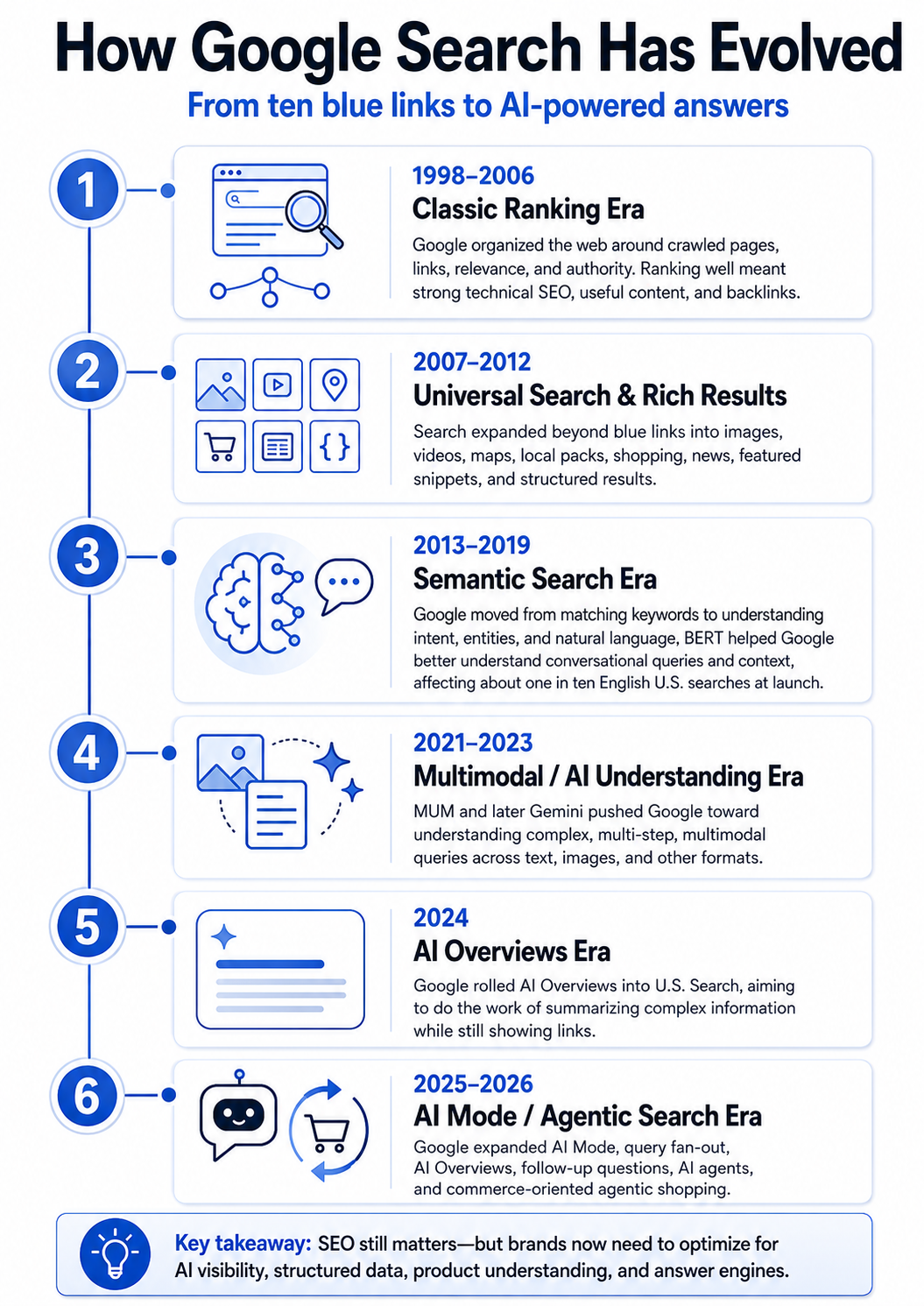
Google Search is going through one of the most significant transformations in its history. For more than two decades, brands have built SEO strategies around a familiar model: optimize your website, earn authority, rank for valuable keywords, and capture demand from the search results page.
That model is not disappearing. But it is changing.
At Google I/O 2026, Google announced what it described as a major evolution of the Search experience: a more AI-powered search interface designed for longer, more conversational queries, multimodal inputs, AI-generated summaries, follow-up questions, and agentic experiences that can help users complete tasks directly through Google.
The announcements builds on Google’s recent rollout of AI Overviews and AI Mode, both of which are reshaping how people discover information, evaluate options, and make decisions online. Google has also described AI Mode as using “query fan-out,” a process that breaks a user’s question into subtopics and issues multiple related searches at once to generate a deeper answer.
While Google seems incredibly optimistic about the future of search, some are not so excited about the change. Here at BlueSwitch, we’re keeping an open mind about Google’s pivot towards AI, ever reminding ourselves that when it comes to online search, the only constant is change itself. Luckily, our SEO department has been preparing for this inevitability for quite some time.
The new challenge for SEO is to evolve alongside search engines
For eCommerce brands, this shift matters. Google is no longer just a list of links. It is becoming an answer engine, a comparison engine, a product discovery engine, and, increasingly, a commerce assistant.
That may sound disruptive, especially for brands that have invested in SEO for years. But the right takeaway is not that SEO is over. The takeaway is that SEO is expanding. Brands now need to optimize not only for rankings, but also for AI visibility, product understanding, entity recognition, structured data, and answer engine performance.
For Shopify and B2B commerce brands, the question is no longer simply, “Are we ranking?” It is, “Can Google understand, trust, summarize, compare, and recommend our brand?”
What Is Google AI Mode?
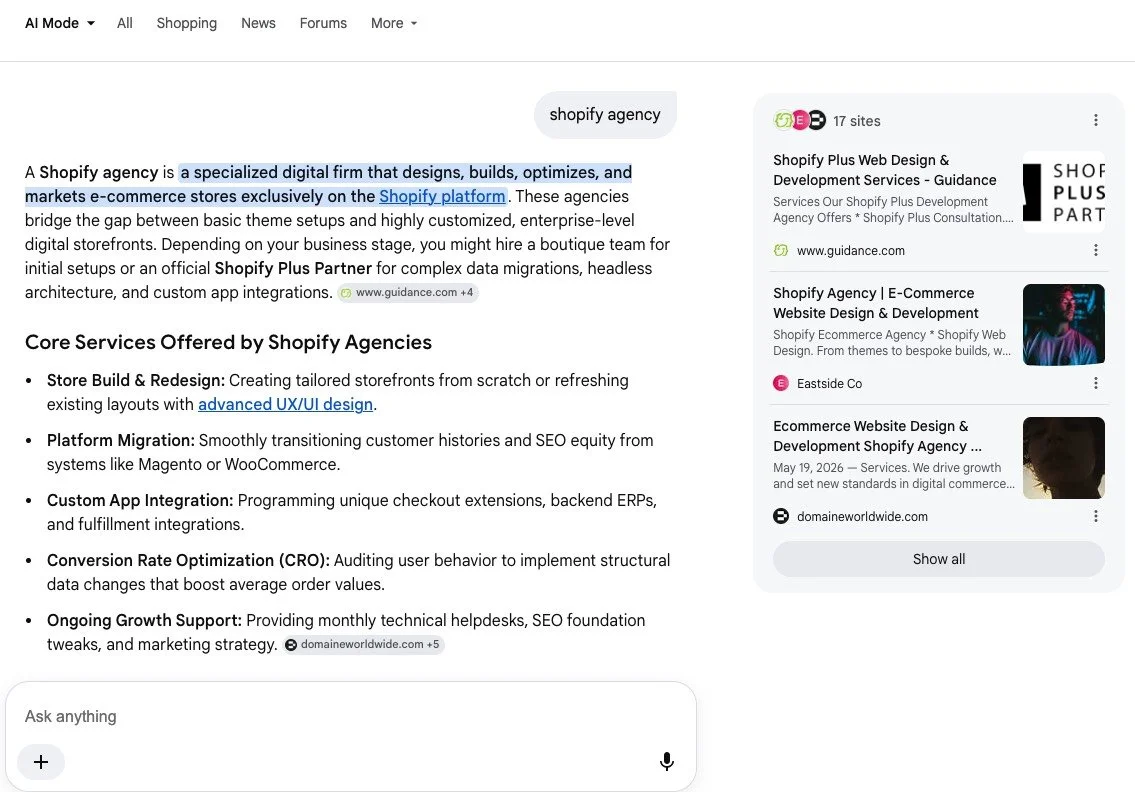
AI Mode is Google’s more conversational, AI-powered Search experience. Instead of returning only a standard search engine results page, AI Mode can synthesize information, answer follow-up questions, and explore subtopics in greater depth.
Under the hood, Google says AI Mode uses query fan-out. That means a single user question may be broken into multiple related searches that Google runs simultaneously. For example, a shopper searching for “best lightweight carry-on for international travel that fits European airline limits” might trigger subqueries related to dimensions, airline restrictions, product reviews, durability, weight, price, brand comparisons, and availability.
For eCommerce brands, Google is changing the practical definition of visibility
A traditional SEO strategy might focus on ranking a collection page for “lightweight carry-on luggage.” That still matters. But in an AI Mode environment, Google may also pull from product pages, buying guides, reviews, merchant feeds, schema markup, comparison content, third-party mentions, and brand authority signals. Visibility becomes less about one keyword and one page, and more about how well your entire digital footprint answers the customer’s decision-making process.
SEO, AEO, and GEO: What’s the Difference?
To fully understand how how your brand will need to adapt to Google’s shift towards AI summaries and conversational search, it’s helpful to break down organic strategy into three distinct parts: SEO, AEO, and GEO.
SEO, or search engine optimization, still focuses on organic visibility in search engines.
AEO, or answer engine optimization, focuses on earning visibility in answer-driven experiences.
GEO, or generative engine optimization, focuses on how brands appear in AI-generated responses.
Google’s new AI Search guidance acknowledges these emerging terms, but reinforces that the underlying foundation is still SEO: useful content, strong technical implementation, crawlability, page experience, structured data, reviews, and content that Google’s systems can understand.
How Will Google’s AI Search Changes Affect My eCommerce Brand?
The impact will vary by category, brand strength, content depth, and technical maturity. But most eCommerce brands should expect changes in three areas: discovery, measurement, and conversion.
Discovery: From Keywords to Entity-Rich Content
First, discovery will become more conversational. Shoppers are likely to ask longer, more specific questions. Instead of searching only for “men’s waterproof boots,” they may ask, “What are the best waterproof boots for walking in snow that still look good with casual outfits?” Google’s AI systems may summarize options, compare product attributes, surface brands, and point users toward products that best match the request.
That means your product information has to be clear and complete. Product pages need more than a title, price, and short description. Collection pages need more than product grids. Buying guides need to be genuinely useful.
Discovery Assets:
Entity-rich content
Product reviews
Store reviews
FAQs and Q&As
Buying guides
Comparison content
Fit guides
Materials information
Warranty details
Shipping policies
Use-case content
Measurement: Say Goodbye to Position Tracking
Second, measurement will become more complicated. Many brands are already seeing volatility in rankings and changes in Google Search Console performance. A common pattern is impressions holding steady or increasing while clicks and click-through rate decline. That does not always mean SEO is failing. It may mean Google is answering more queries directly in the SERP, showing AI Overviews, or changing how users interact with search results before clicking.
For eCommerce stakeholders, this requires a more mature reporting model. Organic sessions and keyword rankings still matter, but they should be analyzed alongside revenue, assisted conversions, branded search demand, category-level visibility, AI Overview visibility, product feed performance, Merchant Center health, and structured data coverage.
Measurement Assets:
Shopify Analytics
Shopify Marketing Report
Google Analytics GA4
Google Search Console
Google Merchant Center
Google Data Studio
SEMRush AI Visibility (included with BlueSwitch AEO services)
Triple Whale
Conversion: Get Ready for AI-powered Shopping
Third, conversion paths may shift. Google is increasingly interested in helping users move from search to action. For commerce brands, that could mean more product discovery and comparison happening before a shopper reaches your site. It could also mean new opportunities to appear in AI-powered shopping surfaces if your product data, site structure, and brand signals are strong.
Conversion Assets:
Shop and Shop Pay
Shopify Agentic Storefronts
Shopify Knowledge Base
Google Merchant Center
Shopify’s Google & YouTube App
Apple Pay
Google Pay
Paypal
Are Keyword Rankings Still Relevant?
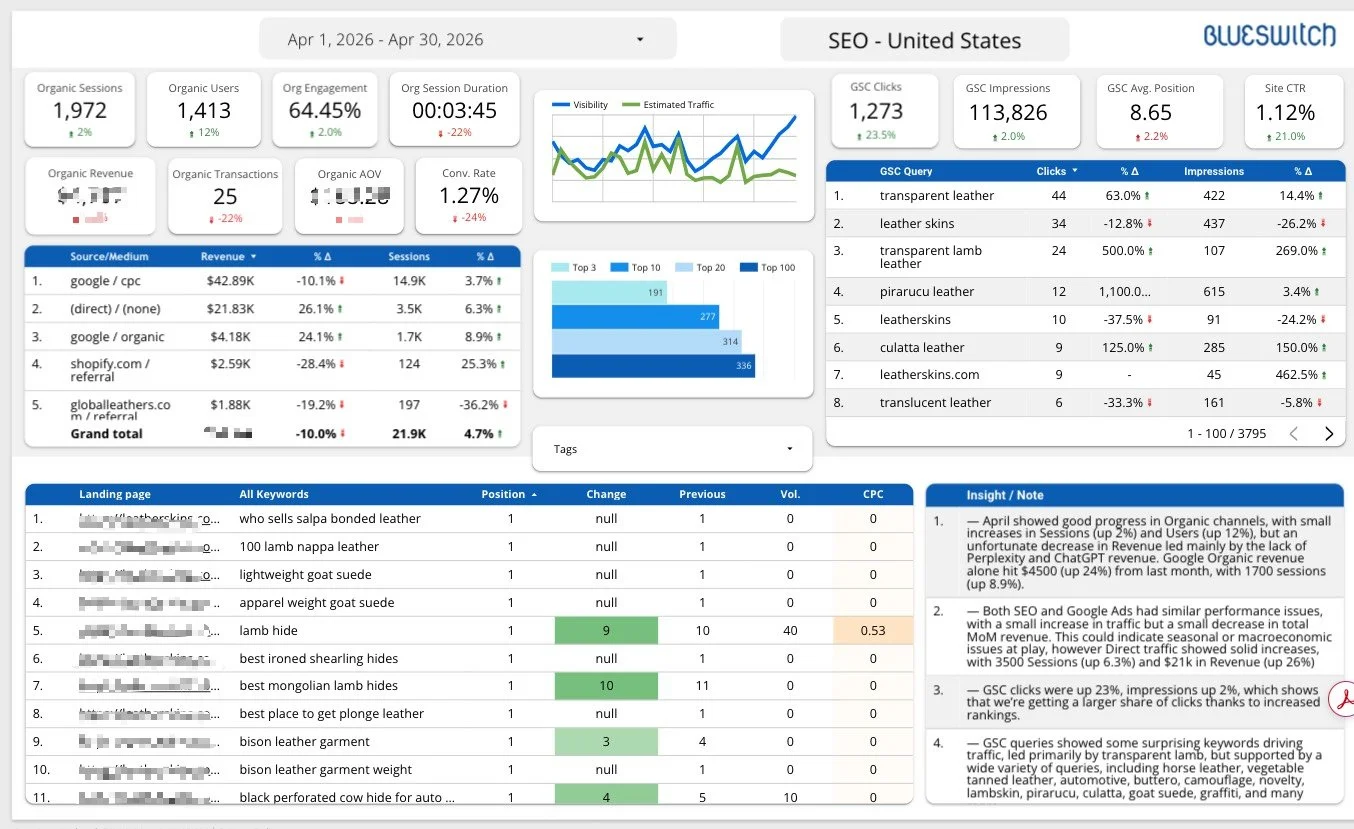
Yes. Keyword rankings are still relevant. But they are no longer enough on their own.
Keywords remain an important signal of demand. They help brands understand how customers search, what language they use, what problems they are trying to solve, and where they are in the buying journey.
But modern SEO cannot stop at keyword targeting.
Google is increasingly focused on intent, entities, context, and usefulness. That means brands need entity-rich content that clearly explains who they are, what they sell, who their products are for, how their products compare, and why customers should trust them. A category page optimized only around a target keyword may not be enough if it does not help users make an informed decision.
When it Comes to eCommerce, Context is Everything
For eCommerce brands, this has practical implications:
Product pages should include detailed, original descriptions.
Collection pages should include helpful context and internal links.
Buying guides should answer real customer questions.
Blog content should support product discovery, not exist as generic SEO filler.
Schema markup should reinforce product, review, FAQ, organization, and breadcrumb information where appropriate.
Merchant feeds should be accurate and complete.
Keyword rankings are still part of the SEO game, but AI search rewards brands that build topical authority, product clarity, and trust across the full customer journey.
Why Google Search Console May Look Worse Even When SEO Is Working
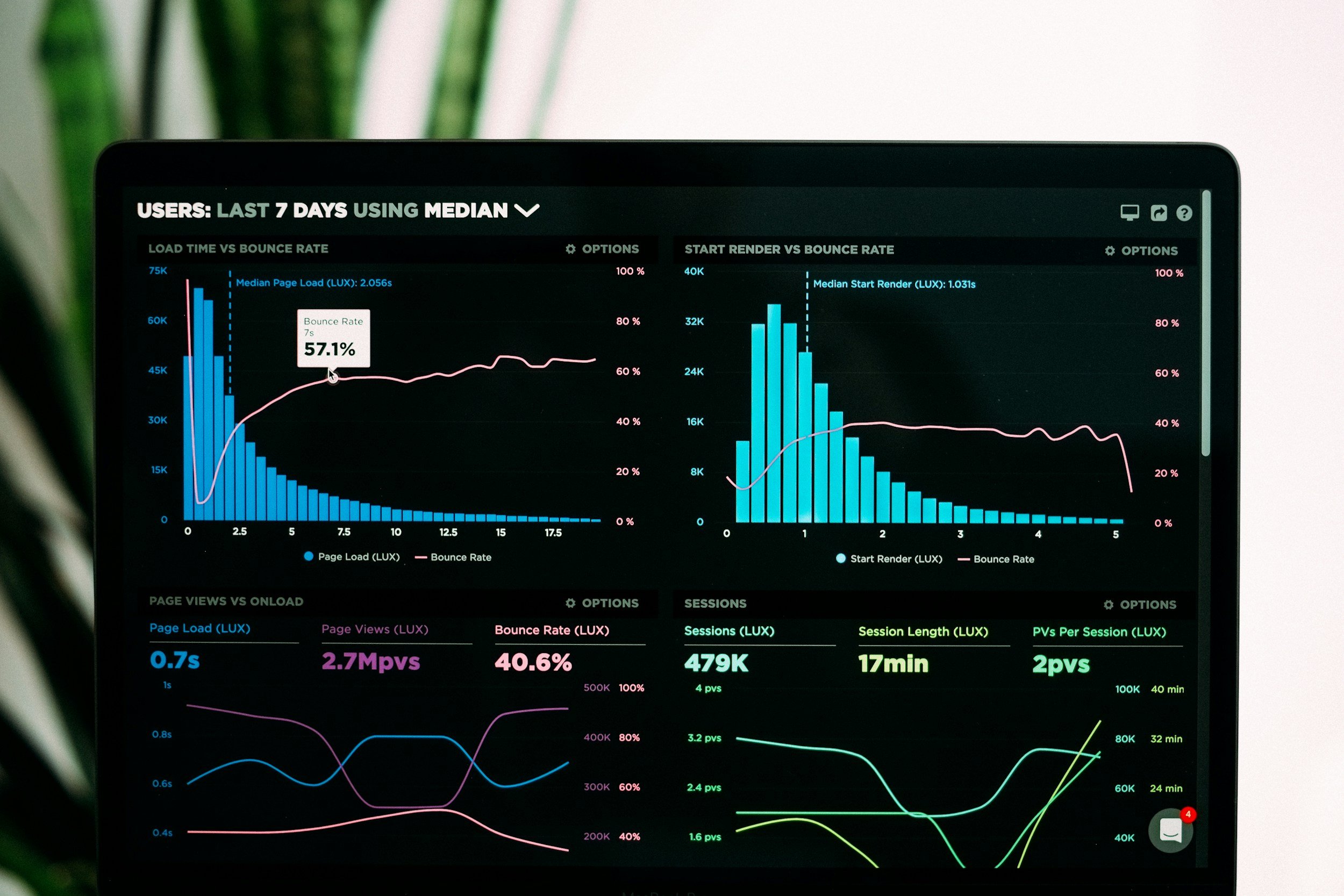
One of the biggest concerns for brands right now is declining performance in Google Search Console. When clicks or CTR fall, the natural reaction is to assume rankings have dropped or SEO has become less effective.
Sometimes that is true. But not always.
AI Overviews, featured snippets, shopping modules, local packs, and other rich results can all change click behavior. If Google gives users more information directly in the results page, some searches may become zero-click searches. Users may still see your brand, learn from your content, or encounter your products, but they may not click in the same way they did before.
eCommerce Brands Must to Update How They Evaluate Organic Performance
Instead of asking only, “Did organic traffic go up?” brands should also ask:
Are we visible for the right commercial and informational intents?
Are our priority collection and product pages gaining or losing impressions?
Are branded searches increasing?
Are we earning visibility in AI summaries, rich results, and shopping surfaces?
Are organic visitors converting at a higher rate, even if total clicks are lower?
Are our product feeds, schema, and Merchant Center data supporting discovery?
Are we building content that answers comparison and decision-stage questions?
The goal is not to ignore traffic declines. The goal is to understand what is causing them and adapt the strategy accordingly.
What eCommerce Brands Should Do Now
The brands best prepared for AI Search will be the ones that treat SEO as a full-funnel commerce discipline, not a checklist.
✅ Start with technical SEO. Your Shopify store needs to be crawlable, indexable, fast, and logically structured. Collection architecture, image alt text, image filenames, canonical tags, faceted navigation, internal linking, page speed, and structured data all matter.
✅ Next, strengthen product understanding. Google needs clean product data, accurate availability, clear pricing, high-quality images, strong descriptions, reviews, and consistent merchant information. Your product pages should help both customers and search systems understand what each product is, who it is for, and why it is valuable.
✅ Then, build entity-rich content. This means creating content that reinforces your brand, products, categories, use cases, materials, benefits, comparisons, and expertise. It also means aligning content with real customer questions, not just high-volume keywords.
✅ Finally, expand reporting. Track rankings, but do not stop there. Track organic revenue, assisted revenue, content performance, AI visibility, branded demand, Merchant Center performance, schema coverage, and Search Console trends by page type and intent cluster.
Prepared for the Next Era of Search
Google Search is changing. The brands that adapt early will be better positioned to earn visibility, trust, and revenue in the AI-powered search era. For brands that have spent years investing in SEO, this is not the time to panic, but it is also not the time to stand still.
The fundamentals of SEO still matter. Google’s own guidance says generative AI features in Search are rooted in core ranking and quality systems. What has changed is the level of sophistication required.

Struggling to Keep Up with AI? BlueSwitch Can Help.
BlueSwitch helps Shopify brands prepare for this shift with comprehensive SEO and AEO services designed specifically for commerce. As a Shopify Platinum Partner, BlueSwitch understands the technical realities of Shopify architecture, product catalogs, collection pages, structured data, Merchant Center, content strategy, and revenue-driven SEO measurement.
If your brand is seeing ranking volatility, declining organic CTR, confusing Search Console trends, or uncertainty around AI performance, now is the time to modernize your SEO strategy.
Contact BlueSwitch today. We can help your team understand what is changing, identify where your site is exposed, and build a search strategy designed for the next generation of eCommerce discovery.