Introducing GEO: How to Get Your Brand Ready for the Future of Online Search
If you own or manage a Shopify storefront, then it’s virtually guaranteed that AI is changing the way you do business online—for better or for worse. 2026 will go down in history as the year that AI became an irreplaceable part of the digital economy, driving everything from content creation and web development, to steering the purchasing decisions of an increasingly large segment of users.
But while studies show that 78% of businesses have adopted some form of AI to power their business functions, the strategy for optimizing their websites for AI answer engines is often still a black box, leaving store owners with lots of questions that don’t have definitive answers.
Over the last five years, the BlueSwitch SEO team has been at the forefront of the AI commerce revolution. From our very first AI subscription way back when Jasper was still called Jarvis, to early adoption of Shopify Magic, to mastering Sidekick and Shopify agentic storefronts, BlueSwitch has been researching, testing, and leveraging AI tools since the beginning.
In this post, we’ll break down the strategies we’ve used to successfully guide our clients into the world of artificial intelligence—while showing you how to boost visibility in AI-driven search, elevate eCommerce performance, and drive stronger discovery, acquisition, and long-term customer retention.
How businesses are using AI to power their workflows
Set aside for a moment the ways that most eCommerce brands have already made AI part of their workflows. AI-powered chatbots communicate with customers to answer questions and make product suggestions, agentic storefronts act as digital personal shoppers, Large Language Models are used to write everything from ad copy to product descriptions to blog posts, image generators create stunning, royalty-free visuals, video production and animation tools power dynamic video content, generative AI tools create hyper-realistic product imagery, and social media teams use AI to create mountains of engaging content, featuring imaginary people using imaginary products to have amazing experiences in places that don’t actually exist.
How customers are using AI to power their shopping decisions
But while the eCommerce and web marketing industry is using AI to create unique and engaging storytelling experiences at scale, the people we’re targeting with these AI-driven experiences are using AI in a completely different way. Shoppers are using AI to research their purchases, and AI-answer engines are helping them find the best prices, the newest promotions, the most relevant reviews, the highest quality products, the biggest discounts, and the best bang for their buck.
Search engines are still relevant, but they’re increasingly serving navigational and transactional results that help shoppers complete their purchase, while AI provides the commercial and informational content that begins most online shopping adventures. Traditional search is still the go-to platform for fact-finding and exploring the web, but a new era of AI-driven search is already upon us. The question is whether your web presence is tuned for both platforms, or are you still focused solely on SEO?

Let’s talk about GEO: Generative Engine Optmization
Instead of talking about the ways that businesses can use AI to improve workflows and enhance the customer experience, let’s talk about the ways eCommerce brands and Shopify storefronts can use AI to increase discovery, drive traffic and revenue, and attract new customers. In other words, let’s talk about GEO.
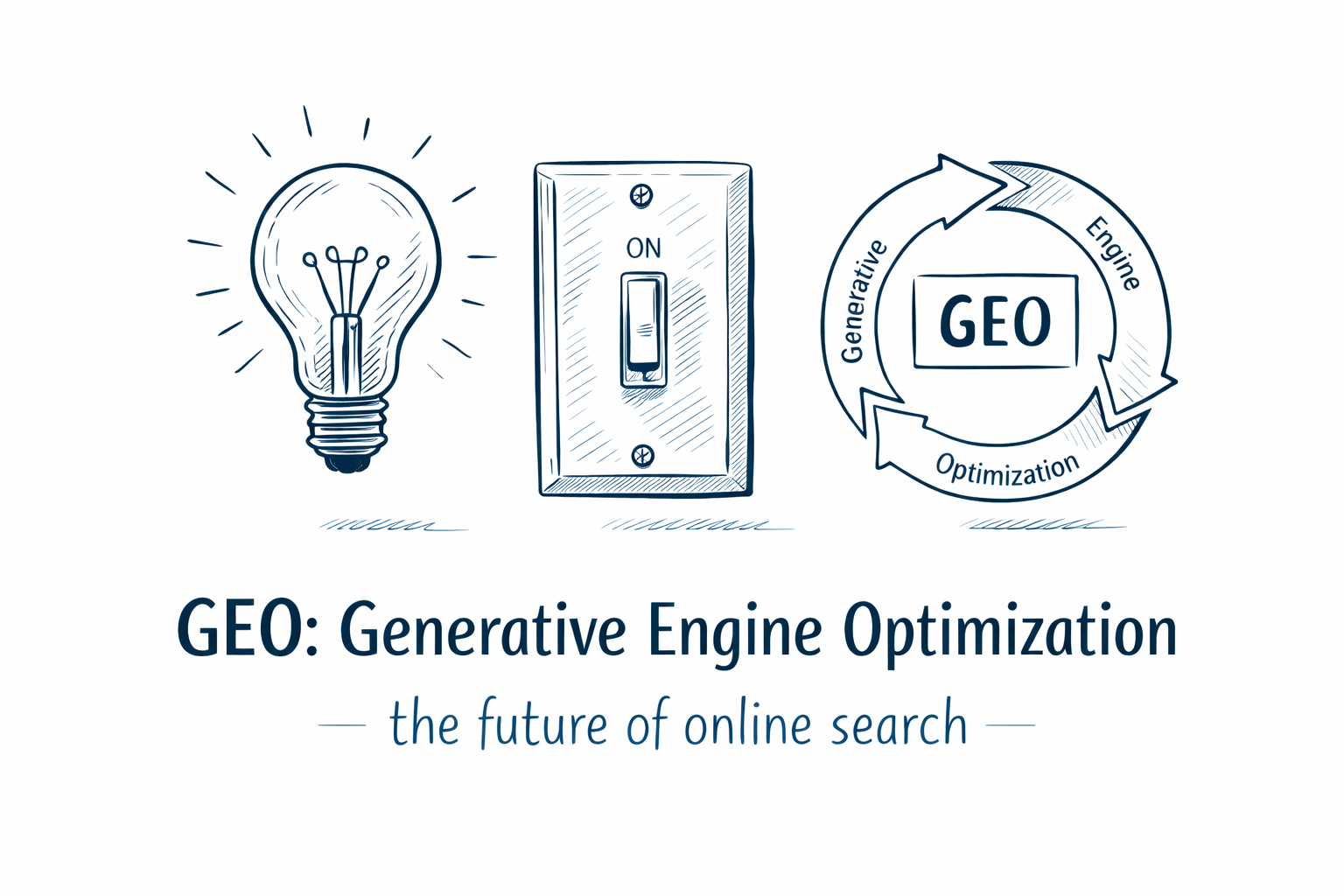
GEO stands for Generative Engine Optimization, the process of optimizing your website and external digital properties for maximum visibility in AI channels like ChatGPT, Google Gemini, Perplexity, and Claude. GEO adheres to many of the same principles as SEO, prizing useful, helpful, people-first content, clean structured data, and off-page signals like product reviews, social media posts, and backlinks.
Still widely considered to be an offshoot of SEO (Search Engine Optimization), the GEO process goes by many names. Some people call it AEO (Answer Engine Optimization), or AIO (as in AI Optimization), and there’s bound to be someone out there who calls it LLMO (Large Language Model Optimization). But whatever you choose to call it, there’s no denying that AI answers, AI summaries, and AI-driven search have changed the face of SEO and digital marketing forever.
The world’s most complex machine doesn’t come with an instruction manual
Unfortunately, there’s no official instruction manual for optimizing websites for AI platforms. At the time of this writing, ChatGPT, Claude, and Perplexity, easily the most recognizable names in AI, haven’t released any official documentation on how their algorithms measure the quality of websites, products, and services.
This lack of documentation is no surprise, considering that Google was founded in 1998, and Google Webmaster Tools (now Google Search Console) came out in 2006, a full eight years after Google became a household name. And it was an even longer wait for Google Search Central, which launched in 2015 and has evolved over the years to become the unofficial SEO instruction manual.
For the first ten to fifteen years of the modern search engine, SEO was largely a process of pattern recognition, trial-and-error, and best-guesses. For the better part of two decades, Businesses and webmasters were flying blind, with no official guidelines for optimizing their sites for search engines.

The SEO principles at the heart of successful GEO
With no official AI documentation available, marketers have suddenly been transported back to the dark ages. Once again, most GEO strategies are little more than a combination of pattern recognition, trial-and-error, and best guesses. However, that's not to say that we don’t have visibility into what works for AI and what doesn’t.
Using analytics and performance data as our guiding light, the battle-hardened SEO team at BlueSwitch has a few verified GEO tricks up our sleeve. This is by no means an exhaustive list, but rather just a few of the strategies we’ve employed to deliver significant results for our clients:
SEO is the starting point for AI visibility
First, it’s important to note that AI algorithms still get most of their information from web searches, so if you’ve never invested in SEO for your brand before, now is the time to start. If you want your business to succeed in AI channels, the best starting point towards that goal is SEO. A fully optimized storefront is the most powerful tool for enhancing AI-visibility for your brand.
AI crawlers aggregate information from a variety of online sources to build a virtual profile of your business, but the best source of information is always going to be the content on your website. We’ve learned through observation and research that AI algorithms are tuned to respond to similar quality signals as search engines, so if your website isn’t optimized for search, you’re not likely to be cited in AI answers.
Invest in high-quality written content
In the age of AI, your site’s content—specifically written content—has become more important than ever. AI crawlers can digest images, video, and infographics, but to fully interpret the context of visual mediums, they require transcripts, captions, alt text, structured data, and other text-based optimizations to make them truly machine-readable.
While you can optimize video content to make it machine-readable, written copy is machine-readable by default. Written content is also more likely to be quoted, cited, or displayed in AI answers, because most AI platforms don’t display external images or video. When you ask AI a question about a brand or product, the answer it returns is most often going to be text-based. If you want to compete in search and AI platforms, investing in useful, helpful, people-first content is not optional, it’s a must.
Suggestions for optimizing your content for AI search
Having high quality written content on your site is a great start, but optimized content is at the heart of any GEO campaign. Optimizing is the process of revising content to maximize visibility, readability, and technical performance—ensuring your content is not only easy for users to engage with, but also structured and refined in a way that search engines and AI systems can effectively interpret, rank, and surface to the right audience. Here are few pointers for optimizing written content for AI answers:
Write for clarity, with concise, accurate statements that don’t editorialize. The goal is for your content to be a clear, credible, trustworthy, and authoritative.
Avoid creative but non-specific statements like “our bags are the best in the business” and instead use concise, informative statements like “our women’s handbags are made from soft, luxurious Italian leather, with high quality YKK zippers and solid brass hardware.”
Large, uninterrupted blocks of text should be broken down into quotable, bite-size chunks. Write for snippets, and assume that only small sections of your content will be pulled into AI-generated answers. Each section should be self-contained and easily understandable if quoted separately.
Use bullet-points to break down lists, instructions, features, and specifications into machine readable, digestible chunks of information.
Optimize your heading tags: learn the H1-H2-H3 hierarchy and apply it to every page of your website. Every page should have one H1 tag, multiple H2’s, and H3’s when applicable.
AI and search crawlers read content in a code-format that we mere mortals can’t see from the frontend. To get a machine’s-eye-view of your content, use a browser extension like SEO Minion to check your site’s heading tags, alt tags, metadata, and other SEO/GEO signals.
Optimize product titles, product descriptions, and collection copy
When it comes to eCommerce storefronts, product and collection descriptions are the best way to enhance visibility and aid discovery in search and AI channels. Think of each field on the edit screen as a mini-sales pitch for your products. When optimizing a product or collection, ask yourself:
Does the product title tell me more than just the name of the product?
Does the product description have useful details that customers want to know?
Does the URL slug tell you exactly what the page is before you click on it?
Does the meta description contain relevant information, or is it just the first sentence of the description?
Try to look at each product or collection as a standalone item, and put yourself in the shoes of a user that’s never heard of your brand or product before. Each element should relay as much information about the product as possible, with the most important information towards the beginning of the field.

Other tips for optimizing product and collection copy for AI answers:
Product titles should be branded, but also should contain broad match language that explains the product to users. Instead of calling your product “The Monica Bag,” try using more descriptive language like “The Monica Leather Crossbody Bag with Zip Closure”
In your product description, mention the product by name throughout the description to reinforce the title and ensure that the description is unmistakably relevant to that specific product.
In each product description, make sure to mention the unique, product-specific details. Include copy that highlights the colorway, features, options, and upgrades to ensure you’re not using duplicate product descriptions for similar products.
Be specific about the materials and parts: Avoid broad statements like “This bag is made of high quality materials,” instead, say “the Monica Crossbody Bag is made from Italian box calf leather, with a high quality YKK zipper closure and brass button feet.”
Use the four pillars of product descriptions: Overview, Features, Benefits, and Specifications.
Start with the overview, explaining in broad strokes what makes your product special.
Then, discuss specific features that customers would find relevant and attractive.
Next, explain the benefits of the product, and how it will make a difference in your customer’s life.
Finally, list off the product specifications, naming specific materials, size, color, dimensions, and other relevant product data.
Avoid sloppy code and code remnants: Descriptions that are copy/pasted from external sources often carry code remnants that can confuse crawlers. If you’re pasting content from a spreadsheet or Google Doc into Shopify, make sure to right-click in the description field and select “paste and match style” (Command+option+shift+V on Mac) to avoid pasting conflicting code in your product descriptions.
Check your existing product descriptions for junk code by clicking the </> code symbol at the top right corner of the description field, looking for odd-looking blocks of code in red text. If you find junk code, return to the regular view of the description, copy it, delete the description, and then right click and re-paste it with the “paste and match style” feature.
Check the Search Engine Listing section: At the bottom of the Shopify edit screen, there’s a section labeled “Search Engine Listing” that contains the SEO Title, Meta Description, and URL slug. Each of these fields should contain as much relevant information as possible within the character limit. Use color, size range, or special features to add more context.
Ensure each element can stand on its own: Before exiting the product edit screen, scroll down the page and look at each element. Look for opportunities to add references to the color, pattern, sizing, materials, features, warranties, and other relevant data that your customers would want to know.
Off-page SEO is more relevant than ever
AI crawlers are constantly scraping the web for content, and the algorithm can do a month’s worth of research in just a couple of seconds. So you can’t assume that their only source of information about your business will be the content on your website.
We already know that ChatGPT has made deals with hundreds of user-generated platforms to scrape the data and see what people are saying about every imaginable subject. From Wikipedia entries to Reddit threads, to review websites like Yelp and Better Business Bureau, assume that AI crawlers are looking at every scrap of information they can find about your business.
This is where the principles of off-page SEO come into play
You can increase the number of inbound backlinks by running a backlinks outreach campaign (or buying backlinks from a reputable source, which we never recommend… even though everyone does it).
Use review aggregators like Birdeye and Trustpilot to build up positive reviews and publish them on multiple reviews platforms.
If you have a brick and mortar location for your business, manage your brand information on referral sites with services like Yext and Moz Local.
Put time and effort into your social media signals by posting high quality, engaging content, with lots of contextual information in the post. Facebook Pages are indexed by Google Search, which means they can be crawled and indexed, making them discoverable in search and AI channels.
Expand into video markets like YouTube, TikTok, and Instagram, and make sure to caption your videos with information-rich descriptions that will help crawlers understand your brand better
Expand your reach by selling your products on third-party marketplaces like Google Merchant Center, Amazon, eBay, Etsy, and Shop. If your products appear in multiple platforms across the web, it enhances your digital footprint and adds density to your web presence, giving crawlers even more opportunities to learn about your brand.
Use press releases and PR services to release brand announcements to a wider audience, and get your brand information published on high authority news sites.

Ask the AI what it thinks about your business
One of the best things about AI answer-engines is that they provide dynamic answers to real questions on any topic you can think of. That means that it’s not just customers that can ask the AI questions about your brand… you can do it too (and you should). Asking the AI questions about what it knows, and more importantly, what it doesn’t know about your business can uncover opportunities that you may not have thought up on your own.
When we begin a GEO campaign, one of the first questions we ask ChatGPT is, “what do you wish you knew about [my brand]?” And the responses have been extremely helpful. From finding out that the return policy is unclear or missing altogether, to learning that the product descriptions are full of messy code that interferes with machine-readability, the AI never fails to uncover a wealth of SEO and GEO opportunities.
Example questions to ask AI answer engines about your brand
Without any official documentation or guidance available from the platforms, asking the AI directly about your brand is the best way to find the holes in your AI presence. As an experiment, go over to ChatGPT, Claude AI, or Google Gemini and ask:
Is there anything about [my brand, website, or product] that you wish you knew?
What are the most important things people need to know about [my business]?
What can I do to get [my brand, website, or products] cited more in AI answers?
Are there any improvements I can make to the products on [your website]?
What are some ways I can improve this product to get cited in more AI answers? [include the specific product URL]
Are there any improvements I could make to [my website] to increase visibility and citations in AI answers? (this one is a personal favorite of the author)

AI is hungry for information about your brand, our job is to feed it
The exciting news is that you, brand owners and managers, are already the ultimate experts on your business. You hold all the key information that AI is actively seeking right now—details about your products, materials, processes, warranties, and unique value propositions. The challenge of GEO isn't in creating new information; it's simply translating your existing knowledge into a clear, credible, and machine-readable format.
When in doubt, blog it out
Even in 2026, blog posts are still one of the most powerful content types for addressing AI answer engines. Blogs offer a unique opportunity to introduce topics and keywords that are related to your brand, but may not fit in any one specific product description. You can use blog post to address common concerns, tell a more detailed story about your brand position, or comment on current events and news items that relate to your brand. Are tariffs temporarily impacting your prices? Blog it. Did you recently receive a patent, award, or recognition for one of your products? Blog it. Do you have a new product line rolling out and you want to highlight the things that make it special? Blog it!
Once your blog is written, it’s time to optimize it:
Insert H2 and H3 subheadings to break up the content into skimmable sections.
Use images with alt tags and links to optimize for image search.
Paste in the embed code from a recent YouTube video to add video content.
Use the SEO title and meta description field to ensure that your post will be found by the right users in search and AI.
Use blog tags to group topical posts together. Tags are an organizational tool, but they’re also great for SEO/GEO, because each tag you create also creates a related “tag page” that is navigable and searchable.
And most importantly, use hyperlinks to highlight high-value keywords and link them to products, collections, and pages of your site. Pages that receive more inbound links are considered “more important” to crawlers, so using hyperlinks with targeted anchor text is a great way to create keyword associations and power-up high-value pages.
Don't be shy about going in-depth: deep-dive blog posts, comprehensive landing pages, and long-form content are excellent ways to provide the dense, authoritative data that AI models rely on for generating rich, contextual answers. The more specific, helpful, and detailed information you provide about your brand, products, and services, the greater your digital footprint and the higher the probability of your brand being cited in AI answer engines.
Succeeding in the age of AI answers
Succeeding in the age of AI might seem like a black box full of mystery and unanswered questions, but the truth is, we already know the most important things about how AI works, what it’s looking for, and how to tune our content for maximum visibility. Just like search engines, AI platforms run on data and information. The more data we provide, the more relevant information we publish, the more likely we are to succeed where others have faltered. AI isn’t an impossible dream, it’s an achievable goal, and most importantly, it’s nothing to be afraid of.
When in doubt, just remember: You can do this, and BlueSwitch can help.