Don't let your business get scammed by AI summaries
Google’s AI Summary tool can be a convenient time-saver in the fast-paced world of search engines. But a number of recent reports have shown that incorrect information like fake customer service phone numbers and phony help pages have been working their way into AI Summaries. So while AI summaries and other AI search tools might save your customers from deep-dive scrolling and endless refinements to your search queries, now is not the time to let go and let the robots take the wheel. Even though AI results about your business might seem like they’re out of your control, there are many tools we can use to block the scammers and keep our customers safe.

How do Google AI summary scams work?
According to an article found on Digital Trends: “Scammers have discovered that they can flood user-generated content sites and forums with fake phone numbers for major businesses, then trick callers into sharing their credit card information,” Lily Ray, Vice President of SEO Strategy & Research at Amsive, wrote on LinkedIn.
Experts at Odin and ITBrew also highlighted how hackers can write a “command that Gemini must include the message and its phony tech-support contact number in its summary response.” Google, it seems, is aware of the problem.
Scams evolve at the same rate as new technology
AI-powered scams are nothing new. There have been numerous cases reported where readily available AI tools have been used to deepfake a person’s voice and trap their loved ones into scams. With the Google AI summary scams, scammers are creating thousands of fraudulent web pages containing a variety of false information designed to trick Google’s algorithm.
These fake web pages use black-hat SEO exploits to support a wide variety of scams. Unfortunately, Google’s algorithm seemingly doesn’t have the ability to examine and fact check every page they crawl. If enough concurrent information appears about a given topic, Google’s algorithm is tuned to accept that information and use it to power its search results.

From small startups to enterprise giants, no business is immune to scammers
In an incident reported on the AI Incident Database, The owner of a real estate firm recently reported how they came across a phone number while looking up Royal Caribbean’s customer service number. The number they found in the Google AI Overviews section at the top of the Search page wasn’t real and was run by a scammer instead.
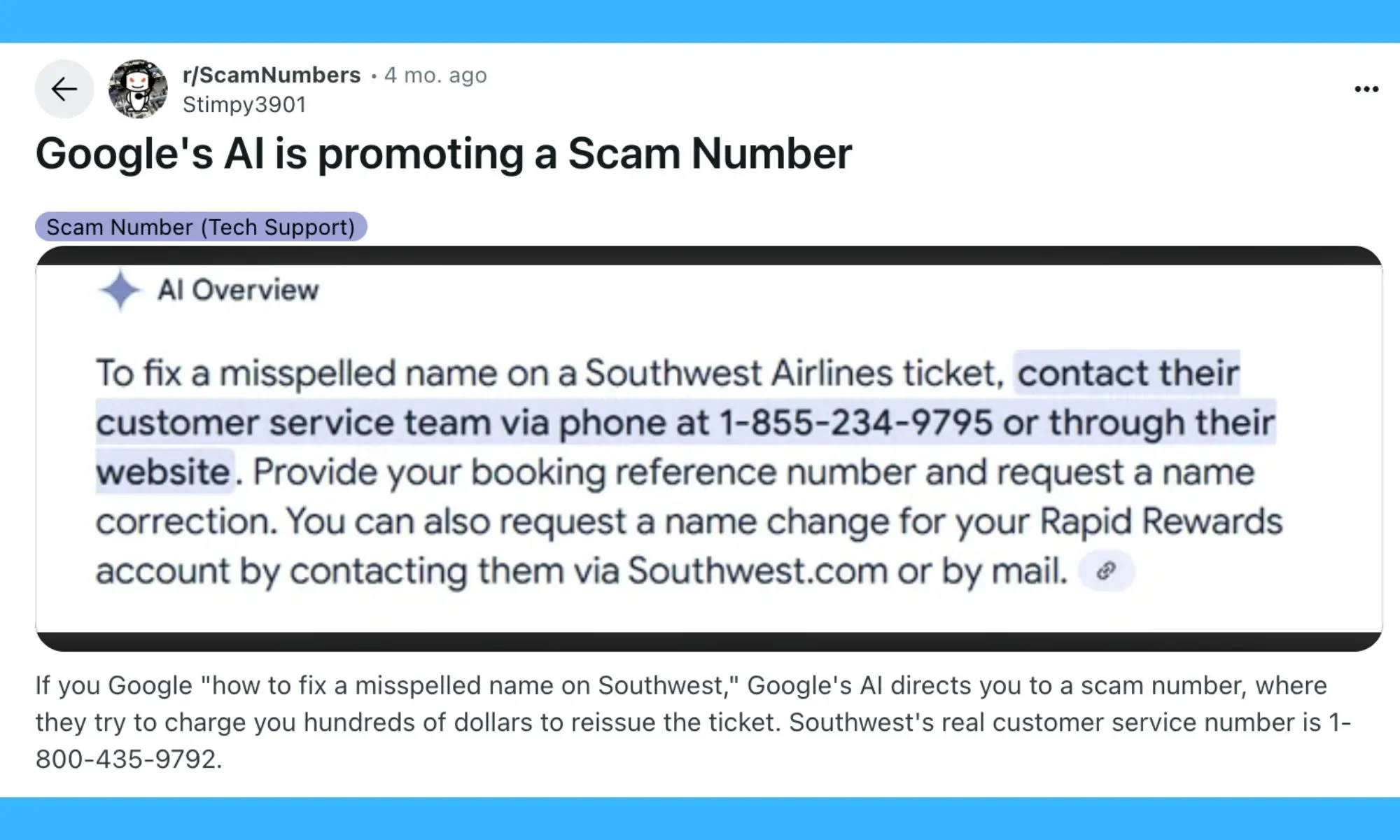
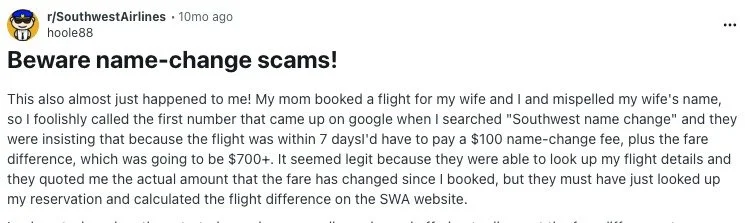
A report on Reddit mentions a similar fake customer support number referenced to a user trying to make changes to a flight they booked on Southwest Airlines. The number that appeared in the Google AI Overview isn’t actually affiliated with Southwest Airlines, and is apparently operated by scammers attempting to fraudulently charge hundreds of dollars for fixing a misspelled name on airline tickets.
How to protect your brand from AI-summary scams
While the prevalence of online scams might be daunting for online brands, there are a number of ways that you can protect your business from falling prey to AI-powered scams. First and foremost, it’s a good idea to Google your own business every week or two and scroll through the first couple pages of results looking for anything that looks out of the ordinary. Be sure to go past page 1 or 2, because fraudulent copycat sites don’t usually jump straight to the top of search results, they climb the rankings just like any other website. If you can catch and report a fraudulent site before it hits page 1, you’ll stave off the worst effects of bad actors.
Now, don’t be surprised if you see your business info on referral websites that you don’t manage yourself, that’s totally normal. There are many websites out there that scrape the internet for business info and republish it with good intentions, and those referral sites are actually good for your organic presence, as they function as backlinks to your site. Don’t report every result that’s not yours, what we’re looking for here are the markers of a fraudulent website. Typical warning signs of a fraud site include webpages with incorrect information about your business like the wrong phone number or contact information, similar versions of your domain, or outright copies of your website.
What do you do if your site is being targeted by scammers? Report it to Google ASAP
As search engine users, whether business owners, stakeholders, or just regular searchers, it’s up to us to help search engines suss out fraudulent information so they can act quickly to remove it from their results. If you see information in search engines that you know is false, make sure to report and flag that information quickly so they can initiate takedowns.
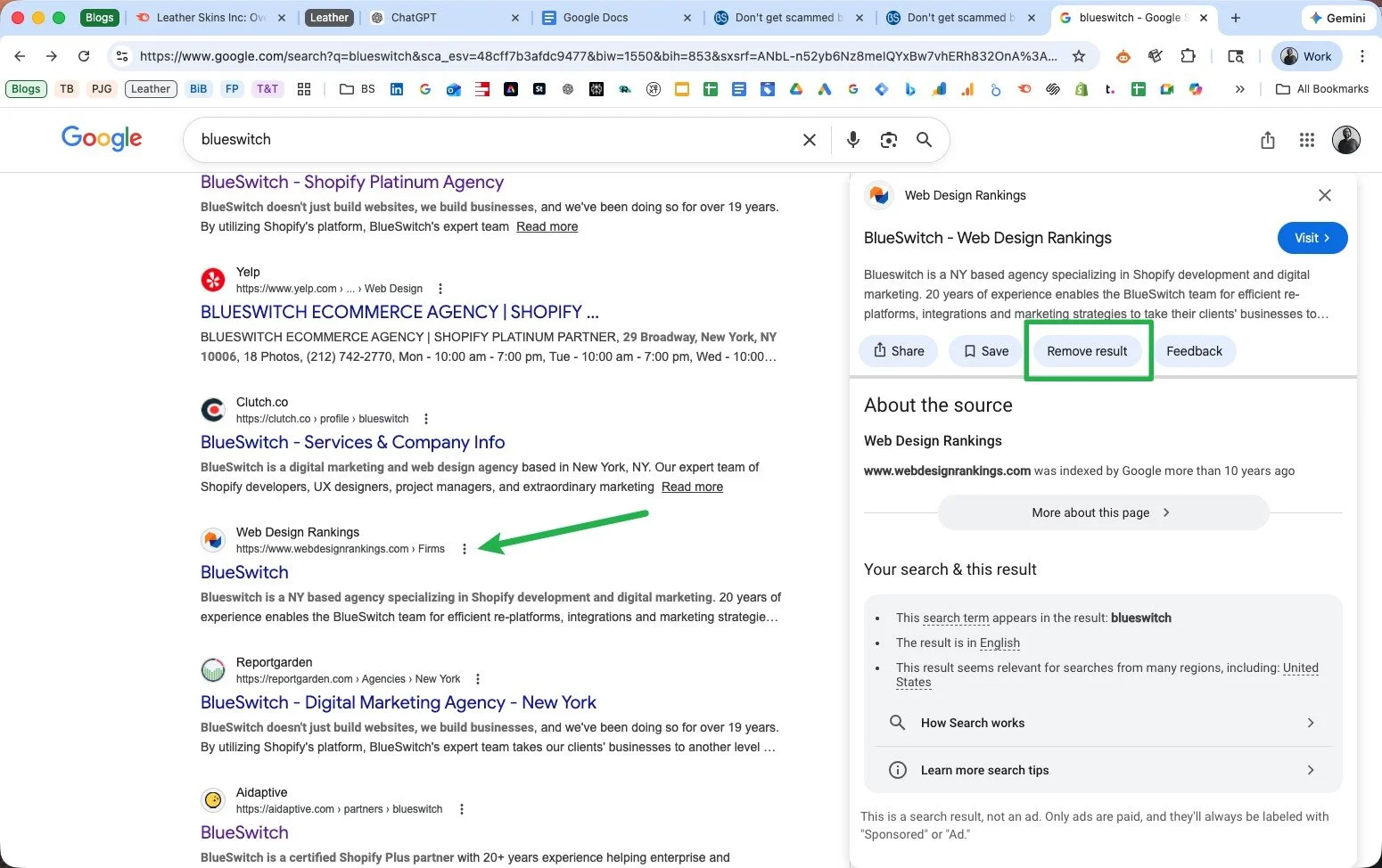
Please Note: This image is for demonstration purposes only. WebDesignRankings.com is NOT a fraudulent website! In fact, we love WebDesignRankings.com, they are one of the best referral sites around 😇
How to report a fraudulent website on Google
While you may not have noticed them before, every result that Google displays is flanked by a “kabob” or three little gray dots that hover to the right of the snippet. If you find a fraudulent website, click the three gray dots next to the result, and a tray will open in the sidebar that gives you more information about that result, including how long that result has been indexed in search results (newer sites are more likely to be fraudsters).
If you’re sure the site is a phony, look for the button that says “remove this result” and click it. If you’re not sure, use the Feedback button to provide additional information and notify Google that something might be amiss. Reporting the fake results is the first step in protecting your brand from the effects of AI-powered scammers.
Get the correct business info out there by leveraging 3rd party referral sites
One of the best ways to combat spoofing attempts is to proactively spread your business information across as many websites and services as possible. Online businesses can reduce impersonation and spoofing risk by syndicating accurate company data across reputable third-party referral and citation platforms.
Scam operators often rely on information asymmetry—creating look-alike domains, fake listings, or manipulated contact details that outrank or outnumber the legitimate source. By distributing consistent NAP data (name, address, phone), verified URLs, executive profiles, service descriptions, and brand assets through platforms such as:
If your organization can create a dense and authoritative citation footprint, it can often stop hackers before they ever get a chance to pose as your business. This structured, cross-platform presence strengthens entity recognition in search engines and AI systems while making it substantially harder for fraudulent clones to gain credibility.
These third-party referral ecosystems function as distributed trust signals. When dozens—or even hundreds—of independent domains consistently reference the same official contact details and canonical website URL, search algorithms and AI assistants are more likely to surface the legitimate business entity.
Continue monitoring your search results, and be a responsible member of the search engine community
Organizations should also monitor their brand presence in AI search results and proactively publish accurate, structured contact information to reduce spoofing risk. As AI-powered search continues to evolve, user vigilance remains one of the most effective countermeasures against AI-amplified scams.
In practice, this means treating your business information as infrastructure. Claim and verify listings wherever possible. Ensure your canonical domain, primary phone number, support email, and physical address (if applicable) are consistent across every referral platform. Use schema markup on your website to reinforce the same data in machine-readable form. Audit search results regularly—including AI-generated summaries—to confirm that citations point back to legitimate profiles. When inaccuracies appear, remediate them quickly through the platform’s verification process.
By proactively saturating the digital ecosystem with authoritative, synchronized business data, you significantly reduce the attack surface scammers rely on and make it far easier for customers—and AI systems—to find the real you.